
Pumping
Septic Tank Pumping in New Ipswich, NH & Surrounding Towns
Pumping is the one piece of septic maintenance every tank needs on a repeating basis. Done on a sensible schedule it is routine and inexpensive; skipped long enough it turns into leach field work, which is not.
Serving New Ipswich, NH and surrounding towns. Free estimates, credit cards accepted.
(603) 554-7276What's involved
Step by step
1. Locate and open the tank
We find the tank and its access lids — with a riser that means lifting a cover, and without one it means digging down to the lid first. If nobody knows where the tank is, locating it is part of the job.
2. Check what's in there
Before anything comes out, the levels tell a story: how deep the sludge layer has built on the bottom, how thick the scum layer is floating on top, and whether the liquid is sitting at, above, or below the normal outlet level. A tank overfull of liquid points at the outlet side rather than the tank.
3. Pump the tank out
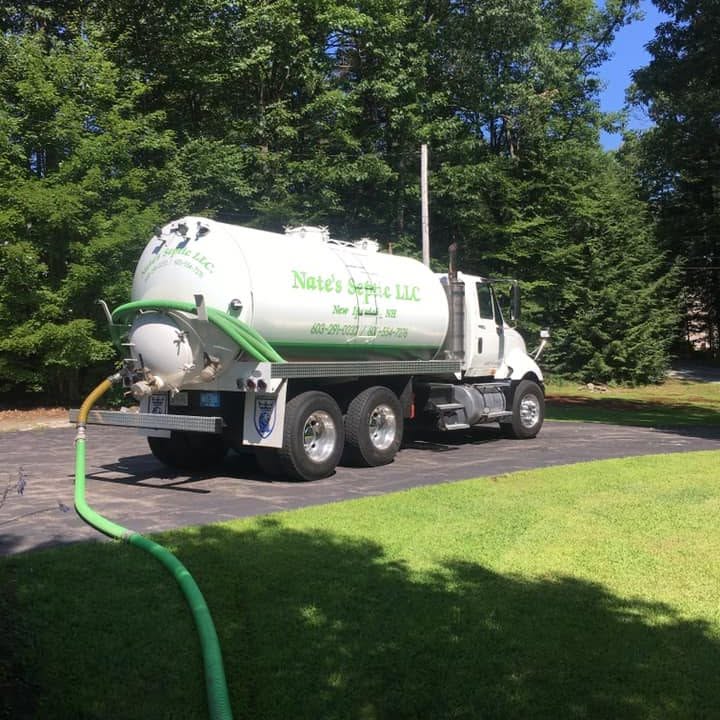
Liquid, settled sludge, and floating scum all get pumped into the truck. This is the difference between pumping and cleaning a tank — skimming the liquid off leaves the solids that actually caused the problem sitting on the bottom.
4. Look at the inside of the tank
With the tank empty the components are visible: inlet and outlet baffles or tees, the condition of the concrete, and whether the walls or lid show damage. If something is broken, you hear about it while the tank is open rather than a year later.
5. Close up and haul away
Lids get reseated, any dug access is backfilled, and the waste is hauled to a licensed disposal site. If the lids were buried, that is the natural moment to talk about adding a riser so the next visit doesn't start with a shovel.
Signs you need it
- Several fixtures draining slowly at the same time, not just one sink
- Gurgling from toilets or tubs when water goes down elsewhere
- Sewage odor indoors, near the tank, or out over the yard
- Wet, spongy ground or unusually green grass above the tank or leach field
- Sewage backing up into the lowest drain in the house
- You've owned the house a few years and nobody can tell you when it was last pumped
How often does a tank need pumping?
The general industry guidance for a typical household is every three to five years, but that's a starting point rather than a rule. Tank size, how many people live in the house, laundry volume, and whether you run a garbage disposal all move the number — a small tank serving a full house can need it far sooner than a large tank serving two people. Requirements and recommendations vary; NH DES has the details for New Hampshire specifics. If you don't know the last date, having it checked is the cheap version of finding out.
Why homeowners call Nate
The verified basics
15+ years
Over fifteen years of septic and excavation work.
5.0 rating
Overall rating on HomeAdvisor.
Free estimates
No charge for a number on your project.
Cards accepted
Credit card payment accepted.
FAQ
Septic Tank Pumping & Cleaning questions
How long does a septic pump-out take?
The pumping itself is usually the short part. What stretches a visit out is access — a tank with a riser at grade is quick, while a tank buried under lawn with no records has to be located and dug down to first. Ask when you call and we can give you a realistic picture for your property.
Do I need to be home when the tank is pumped?
It helps, especially the first time, because you can point out where the lids are, mention anything the system has been doing, and hear what we find with the tank open. Talk it through when you schedule.
Should I have the tank pumped before I sell the house?
It's common. A recently pumped tank with a known service date is one less unknown in a sale, and having the tank open is also the moment when baffle or lid problems show up. Inspection requirements at sale vary — NH DES has the details.
Do additives mean I can skip pumping?
No. Solids accumulate in the tank regardless, and nothing you pour down a drain hauls them away. The only thing that empties a tank is a truck.
What does it cost?
Pumping price depends mainly on tank size, plus access and site conditions. Our published ranges are on the pricing page, and project estimates are free — call and describe your setup for a number on your system. Credit cards are accepted.
Related
Other work we do
Drain Clog & Blockage Clearing
Slow drains, gurgling fixtures, or a backup — we find where flow stops between the house and the tank and clear it.
Read moreSeptic Riser Installation
Bring buried tank and D-box openings up to grade so future pumping and inspection means lifting a lid, not digging the lawn.
Read moreUrgent Septic Help
Backing up right now? Symptom checklist, what to do while you wait, and the number to call. Septic problems get worse fast.
Read moreFree estimate
Tell us what's going on
Send the basics — and photos of the tank, the yard, or whatever you're seeing if you have them — and we'll get back to you with a free estimate. In a hurry? Calling is always fastest.
(603) 554-7276Serving New Ipswich, NH and surrounding towns. Credit cards accepted.